Japanese Charizard Card Price Guide for Qatar (QAR): Ranges, Highlights and How to Buy
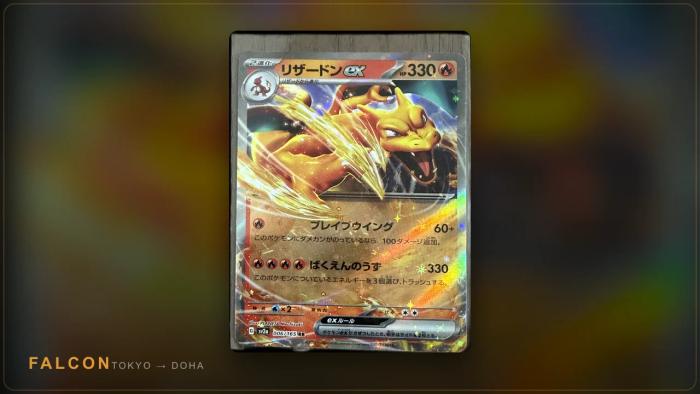
Charizard is the single most searched Pokemon card character in the world, and Japanese Charizard cards hold a special place for collectors in Qatar. Japanese prints are famous for sharp print quality, distinctive artwork, and set structures that differ from the international releases, which is exactly why demand from Doha and across the GCC keeps climbing. But Charizard is also one of the most misunderstood cards to price, because a single name covers dozens of very different cards spanning from 1996 to today, each with its own supply, grading behaviour and market rhythm. This guide is written for buyers in Qatar who want to understand what they are actually paying for, converted into an approximate QAR frame, before committing. Every number here is a range, not a fixed price. Card markets move week to week, and the figures below are best read as a snapshot to orient you, not a quote. Whenever you are close to buying, confirm the live figure for the exact card, set, language and grade in front of you. We will walk through the major Charizard families collectors ask about, explain the value axes that actually move price, and then cover the Qatar-specific practicalities: customs expectations, PSA 10 economics, and how to store cards in a hot, humid Gulf climate. The goal is not to hand you a price tag. It is to make you a sharper buyer who can read a listing, spot what drives the number, and decide with confidence.
Why Japanese Charizard cards are their own market
It is tempting to treat Charizard as one asset, but the reality is that the name spans a huge spread of cards with almost nothing in common except the character. A 1996 Base Set holo, a 2005 Gold Star, a modern Special Art Rare and a promo card can differ in value by two or three orders of magnitude. Japanese prints add another layer, because the Japanese release schedule, rarity tiers and print runs do not map one to one onto the English sets many collectors first learned. Understanding that structure is the first step to pricing anything sensibly.
Japanese cards are prized for a few consistent reasons. Centering and print consistency tend to be strong, which matters enormously at the top grades. The artwork on modern Special Art Rare and Character Rare cards is often considered the definitive version. And certain vintage Japanese prints had smaller distribution than their English counterparts, which tightens supply. None of this guarantees a higher price than the English equivalent, but it does mean Japanese Charizard cards trade on their own logic and should be researched on their own terms.
The major Charizard families and their price ranges
Below are the Charizard cards Qatari collectors ask about most. For each, treat the range as an orientation snapshot that varies widely by condition and grade. QAR figures are approximate conversions and must be verified against a live rate and a live listing.
First generation Base Set holo Charizard
The 1996 to 1997 era Japanese Base Set holo Charizard is the foundational grail. Raw copies in played condition can be relatively accessible, but the range explodes upward as condition improves, and high-grade examples sit firmly in premium territory. This is a card where the gap between a lightly played copy and a gem mint graded copy is enormous, so condition is not a detail here, it is the whole story. Confirm the print era and any authenticity markers carefully, because this is also the most counterfeited Charizard family.
Gold Star Charizard
The mid 2000s Gold Star Charizard is one of the most iconic chase cards of its era, with a distinctive shining artwork and famously limited supply. It sits in the high premium bracket, well above most modern cards, and demand has been durable. Because supply is thin, individual sales can swing the visible range considerably, so a single data point should never be taken as the market. This is a card to research across multiple recent sales before forming any expectation.
Pokemon Card 151 Charizard ex Special Art Rare
The 151 set brought a wave of new collectors back to the original 150 plus Mew roster, and the Charizard ex Special Art Rare became one of its signature pulls. As a modern card with a larger print run, it is far more accessible than vintage grails, but the Special Art Rare version still commands a clear premium over standard rarities, and graded gem mint copies carry an additional layer. Ranges here move noticeably around set availability and reprint news.
Black Bolt Charizard Special Art Rare
The recent Black Bolt era Charizard Special Art Rare is one of the newest highly sought Charizard artworks. As a current-generation card, availability is comparatively broad, keeping raw copies more attainable than vintage, but the strongest artworks in a hyped set can still carry a meaningful premium in the early window after release. Prices for very new cards are often the most volatile of all, so a snapshot ages quickly here.
Mega Charizard X and Mega Charizard Y
The Mega Charizard X and Y cards appeal to collectors who favour the Mega Evolution designs. Depending on the specific set, rarity treatment and whether it is a standard or special art version, these span a wide band from accessible to solidly mid-premium. The two forms do not always trade at the same level, and collector preference between the aggressive X and the classic Y shifts over time, so price them separately.
Character Rare and VMAX Special Super Rare Charizard
Character Rare cards, which place Charizard in a stylised illustrated scene, and VMAX Special Super Rare cards from the Sword and Shield era are among the most visually loved modern Charizards. They typically sit in the mid to upper-mid premium band, above common rarities but below vintage grails. Condition sensitivity is high on these full-art style cards because edge and surface flaws are easy to spot, which makes graded copies a notable step up.
25th Anniversary Charizard
The 25th Anniversary Japanese Charizard releases sit in a special category driven by anniversary demand and collectible framing. Ranges vary by the specific product and rarity, and anniversary items sometimes carry sentiment premiums that behave differently from standard set cards. Verify exactly which anniversary print you are looking at, since the name covers several distinct items.
The value axes that actually move the price
Once you stop thinking about a single Charizard price and start thinking about axes, pricing becomes far more legible. These are the levers that explain almost every difference you will see between two listings.
- Rarity tier: a Special Art Rare, Character Rare or Gold Star sits far above the same character at a standard rarity, even within the same era.
- Condition and grade: this is usually the single biggest lever, especially for vintage. The distance between a lightly played raw copy and a graded gem mint copy can be several multiples.
- Era and supply: vintage cards with thin surviving supply behave differently from modern cards with large print runs and ongoing availability.
- Print variant and language: first edition markers, print era, and Japanese versus English can each shift the figure meaningfully.
- Population and hype cycle: newly released or freshly hyped cards are the most volatile, while established grails tend to move more slowly.
- Authenticity and provenance: verified authenticity matters most on the highest-value vintage cards, where counterfeits are common.
When you read a listing, run through these axes deliberately. Ask which rarity tier this is, what the true condition looks like, whether the supply is thin or broad, and whether the price reflects a current hype spike. A number that looks high or low almost always resolves once you place it on these axes.
Understanding PSA 10 and graded value
For higher-value Charizard cards, professional grading is central to how the market prices them. A graded gem mint copy is not simply a nicer version of a raw card, it is a distinct market with its own demand. The premium for a top grade over a raw copy grows dramatically as the base card value rises, which is why grading economics matter before you buy either a raw card hoping to grade it, or a slab at a premium.
A few principles help. The gem mint premium is largest on cards where high grades are genuinely scarce, so a card that grades easily carries a smaller top-grade premium than one that rarely comes back perfect. Population reports, which count how many copies exist at each grade, are a key reference for understanding that scarcity. And grading has costs and turnaround times of its own, plus the risk that a raw card grades lower than hoped, which can erase the intended margin. For a buyer in Qatar, factor in that submitting cards for grading typically means international shipping in both directions.
Approximate QAR figures and why they need verifying
Most Charizard market data is denominated in yen, dollars or euros, so any QAR figure you see is a conversion, not a native price. That adds two layers of uncertainty on top of the normal market movement: the exchange rate on the day, and any conversion spread applied by the payment or platform. This is why every QAR figure in this guide is described as approximate and requiring verification.
For practical budgeting in Qatar, treat the QAR frame as a planning estimate. Anchor your expectation in the source-currency market first, then convert at a live rate close to the moment of purchase, and add a margin for spread. Do not lock a budget to a QAR figure you saw weeks earlier, because both the underlying market and the rate will have moved.
- Anchor first in the card's usual quote currency, then convert to QAR.
- Use a live rate near the time you actually buy, not an old one.
- Add a margin for conversion spread and payment fees.
- Re-check on the day for volatile modern releases, where snapshots age fastest.
Qatar context: customs, delivery and total cost
When importing a Japanese Charizard card into Qatar, the sticker figure is only part of the total cost. Cross-border shipping, insurance for higher-value cards, and any applicable customs handling should all be factored into your real outlay. Higher-value cards in particular benefit from tracked, insured shipping, and the cost of that protection is small relative to the risk it covers.
Customs treatment and any duties or handling depend on current regulations and the declared value, and these can change, so treat the specifics as something to confirm rather than assume. The practical takeaway is to think in terms of landed cost: the card price plus shipping plus insurance plus any import handling, expressed in QAR. A card that looks cheap before shipping can look quite different once fully landed, especially for lower-value cards where shipping is a large share of the total.
Storing Charizard cards in the Gulf climate
Qatar's heat and humidity are genuinely relevant to card preservation, and for valuable Charizard cards, storage is part of protecting the value you paid for. Heat can warp cards and degrade holo surfaces over time, and humidity is the enemy of both raw cardboard and even graded slabs if condensation forms. The good news is that sensible, low-cost precautions handle almost all of the risk.
- Keep cards in a climate-controlled indoor space, away from direct sun and away from windows that heat up during the day.
- Use protective supplies for raw cards: a penny sleeve inside a rigid holder, and avoid loose handling.
- Manage humidity with a stable indoor environment, and consider desiccant in a sealed storage box for higher-value cards.
- Avoid rapid temperature swings, such as moving cards between a hot car and a cold room, which can cause condensation.
- For graded cards, still avoid heat and direct sun, since slabs protect against handling but not against thermal stress.
None of this is expensive, and it is far cheaper than the value lost if a premium card degrades. Treat storage as a fixed part of collecting in Qatar, not an afterthought.
A practical buying checklist for Qatar collectors
Pulling it together, here is a sequence that turns the ideas above into a repeatable buying process. Following it consistently is the single best defence against overpaying or buying the wrong card.
- Identify the exact card: family, set, rarity tier, print era and language, not just the name Charizard.
- Place it on the value axes: rarity, condition, era and supply, variant, hype and authenticity.
- Check recent sales for that exact card and grade, and treat any single sale as one data point, not the market.
- Judge the physical condition yourself, then use the grade as confirmation rather than the reason to buy.
- Convert to a landed QAR estimate: card plus shipping plus insurance plus any import handling, at a live rate.
- Verify the live figure right before purchase, since every range in guides like this one is a snapshot.
- Plan storage before the card arrives, so it is protected from day one in the Gulf climate.
Frequently asked questions
Why do Japanese Charizard prices vary so much?
Because the name Charizard covers dozens of very different cards spanning from 1996 to today, each with its own rarity tier, print run, era and grading behaviour. A vintage Base Set holo, a Gold Star, a modern Special Art Rare and a promo can differ by two or three orders of magnitude. On top of that, condition and grade alone can move a single card by several multiples. That is why this guide gives ranges as snapshots rather than fixed prices, and why you should always verify the live figure for the exact card, set, language and grade in front of you.
Are Japanese Charizard cards worth more than the English versions?
Not automatically. Japanese prints are prized for strong print quality, distinctive artwork and sometimes tighter vintage supply, and for certain cards they do trade at a premium. But there is no universal rule, and for other cards the English version may be more sought after. Each card trades on its own logic, so compare the specific Japanese card against the specific English card on recent sales rather than assuming one language always wins.
How much does a Japanese Charizard cost in QAR?
There is no single answer, and any QAR figure is an approximate conversion that must be verified. Charizard cards span from relatively accessible modern prints to high premium vintage grails, and prices move week to week. Most market data is quoted in yen, dollars or euros, so you should anchor your expectation in that source currency, convert at a live rate near the time of purchase, and add a margin for conversion spread and fees. Always confirm the current figure for the exact card and grade before buying.
Is a PSA 10 Charizard worth the premium?
It depends on the card. A graded gem mint copy is a distinct market with its own demand, and the top-grade premium is largest on cards where high grades are genuinely scarce. If a card grades easily, the premium over a strong raw copy is smaller. Grading also has its own costs, turnaround times and the risk of a lower-than-hoped grade, and for a Qatar buyer it usually means international shipping both ways. Judge the physical card first and treat the grade as confirmation rather than the sole reason to buy.
Will I pay customs on a Charizard card imported to Qatar?
Customs treatment and any duties or handling depend on current regulations and the declared value, and these can change, so confirm the specifics rather than assuming. The practical approach is to think in terms of landed cost: the card price plus shipping plus insurance plus any import handling, expressed in QAR. On lower-value cards, shipping in particular can be a large share of the total, so a card that looks cheap before shipping may look quite different once fully landed.
How should I store Charizard cards in Qatar's climate?
Heat and humidity are real risks in the Gulf, so keep cards in a climate-controlled indoor space away from direct sun and windows. Use a penny sleeve inside a rigid holder for raw cards, manage humidity with a stable environment and consider desiccant in a sealed box for valuable cards, and avoid rapid temperature swings that cause condensation. Graded slabs protect against handling but not thermal stress, so keep them out of heat and sun too. These precautions are inexpensive relative to the value they protect.
How do I avoid overpaying for a Charizard card?
Follow a repeatable process. Identify the exact card by family, set, rarity tier, print era and language rather than just the name. Place it on the value axes of rarity, condition, era and supply, variant, hype and authenticity. Check recent sales for that exact card and grade, treating any single sale as one data point. Judge the physical condition yourself, convert to a landed QAR estimate at a live rate, verify the live figure right before purchase, and plan storage in advance. Process, not memorised prices, is what protects you.