How to Spot Fake Pokémon Cards in Qatar: A Buyer's Guide
The Pokémon hobby has grown quickly across Qatar, and with that growth has come a familiar problem: counterfeit cards. Fakes now circulate through casual resale groups, unofficial market stalls, and unfamiliar overseas listings, and some of them are convincing at first glance. For a buyer in Doha paying real money for a Japanese single or a sealed box, the difference between a genuine card and a clever reprint can be hundreds of riyals. The good news is that most counterfeits give themselves away once you know where to look. This guide walks through a practical, hands-on checklist you can use before you pay, explains why professional grading matters, and shows how to buy with confidence. Nothing here replaces a professional authentication, and when a card is valuable the safest step is always to have it examined by experts, but these checks will help you filter out the obvious fakes and ask better questions.
Why Counterfeit Pokémon Cards Reach Qatar
Japanese Pokémon cards are printed for the Japanese domestic market and rarely reach retail shelves in the Gulf. That scarcity creates demand, and demand attracts counterfeiters. Many fakes are mass produced overseas and then filtered into resale communities, social media marketplaces, and informal stalls where there is little accountability. Because buyers in Qatar often cannot inspect a card in person before paying, sellers of fakes rely on good photos and vague descriptions to close a sale.
Counterfeits fall into a few broad groups. There are cheap novelty reprints that anyone can identify instantly, low-effort bootlegs that fail basic tests, and higher-quality fakes that copy holographic patterns and card backs closely. The most dangerous category is the proxy or reprint sold dishonestly as genuine, sometimes even resealed into fake grading cases. Knowing that this spectrum exists is the first step, because it means you should never rely on a single test. Real confidence comes from several checks agreeing with each other.
Start With the Card Stock, Weight, and Feel
Genuine Pokémon cards use a specific layered cardstock with a thin dark core sandwiched between two printed layers. This construction gives real cards a consistent stiffness and a particular snap when gently flexed. Many counterfeits use paper that is either too thin and floppy or too thick and stiff, and cheaper fakes often skip the dark inner layer entirely. If you can compare a suspect card against a card you know is authentic from the same era, differences in thickness and flex are often obvious within seconds.
The classic light test remains one of the most useful quick checks. Hold the card up to a bright light. A genuine card is largely opaque because of its inner core, so only a faint amount of light passes through. Many fakes let far more light through, which reveals thin or missing core layers. This test is not perfect on its own, since some higher-quality fakes imitate opacity, but combined with a weight and flex check it filters out a large share of counterfeits.
- Flex the card very gently and feel the stiffness and snap; avoid bending hard, which can damage a genuine card.
- Hold the card to a bright light and watch how much passes through compared to a known-genuine card.
- Look at the cut edge under magnification for the thin dark middle layer.
- Compare weight and thickness against an authentic card from the same set and era.
Examine the Print Quality Under Magnification
Print quality is where most counterfeits fail. Genuine Japanese Pokémon cards are printed to a very high standard with crisp, tightly controlled color. Under a jeweller's loupe or a phone macro lens you can see the printing dot pattern. Authentic cards use a fine, regular rosette pattern of tiny dots, while many fakes show a coarser, blurrier, or differently spaced dot structure. Fuzzy edges on text, doubled or misregistered colors, and a general softness to fine details are all warning signs.
Color saturation and balance are also revealing. Counterfeits often look slightly off: too dark, too washed out, overly saturated, or shifted toward a different hue than the genuine printing. Blacks may look muddy rather than deep, and yellows or blues may appear either dull or unnaturally intense. Because color is hard to judge in isolation, comparison against a known-genuine card of the same print is far more reliable than trusting your memory.
- Under magnification, real cards show a fine, even rosette dot pattern; coarse or irregular dots suggest a fake.
- Check text and line art for sharpness; blurred or feathered edges are a red flag.
- Look for color that is too dark, too faded, or shifted in hue versus a genuine card.
- Watch for misaligned color layers, sometimes visible as a faint ghost or halo around artwork and text.
Check the Back of the Card Closely
The back of the card is one of the most consistent tells because every genuine card shares the same back design, so there is a huge reference pool to compare against. Pay attention to the exact shade of blue, the color of the central swirl, and the crispness of the Poké Ball and Pokémon logo in the middle. Counterfeit backs are frequently the wrong shade, often too purple, too dark, or too faded, and the fine details in the artwork are commonly softer than on genuine cards.
Alignment and centering on the back matter too. Genuine cards are cut within predictable tolerances, so the border framing around the back design is reasonably even. Some fakes show badly off-center backs, uneven borders, or a back that does not line up correctly with the front. While genuine cards can occasionally have off-center cuts, an extreme misalignment combined with any other warning sign should make you cautious.
Fonts, Text, and Energy Symbols
Typography is a favorite hunting ground for counterfeit spotters because official cards use precise, consistent fonts and spacing. On fakes, the font weight is often slightly wrong, letters may be too thick or too thin, and spacing between characters can look cramped or uneven. Small text such as the copyright line, set symbols, card numbers, and illustrator credits is especially useful, since counterfeiters frequently reproduce these areas poorly. Blurry or misshapen small text is a strong warning sign.
Energy symbols and type icons deserve their own inspection. On genuine cards, the energy symbols in attack costs and the type indicators are sharply printed with correct proportions and coloring. Fakes often render these symbols with fuzzy edges, incorrect shading, or subtly wrong shapes. Because these icons are small and detailed, they are difficult to counterfeit cleanly, which makes them a reliable checkpoint. Compare the HP text, attack damage numbers, and symbols against a genuine card of the same type.
- Inspect the copyright and set line at the bottom for correct, sharp small text.
- Compare font weight and letter spacing against a genuine card; fakes often look cramped or too bold.
- Study energy and type symbols for crisp edges and correct color and shape.
- Verify the card number and set symbol match the real set, and are printed cleanly.
Surface, Gloss, Holo Pattern, and Cut Edges
The finish of a card tells you a great deal. Genuine cards have a consistent, controlled gloss, and holographic or foil cards use specific, well-defined holo patterns. Counterfeits often get the shine wrong, appearing either too glossy and plasticky or unnaturally flat and dull. On holo and full-art cards, fakes may show a holo texture that looks grainy, evenly sparkly in the wrong way, or applied over the entire card rather than the correct areas. If a foil pattern looks nothing like the genuine version of that card, treat it as suspect.
The cut edges and corners are a final physical checkpoint. Authentic cards are cut cleanly with smooth edges and consistent corners. Many counterfeits show rough, frayed, or fibrous edges, uneven cutting, or corners that are inconsistent from one to the next. Under magnification a poorly cut edge often reveals loose paper fibers or a wavy line. Combined with the light and stock tests, edge quality helps confirm whether the physical card was made to genuine standards.
- Tilt the card under light to check gloss level and holo pattern against a genuine card.
- Look for holo texture applied only to the correct areas, not smeared across the whole card.
- Inspect edges under magnification for clean cuts versus frayed or fibrous edges.
- Check that all four corners look consistent and cleanly formed.
The Role of Professional Grading
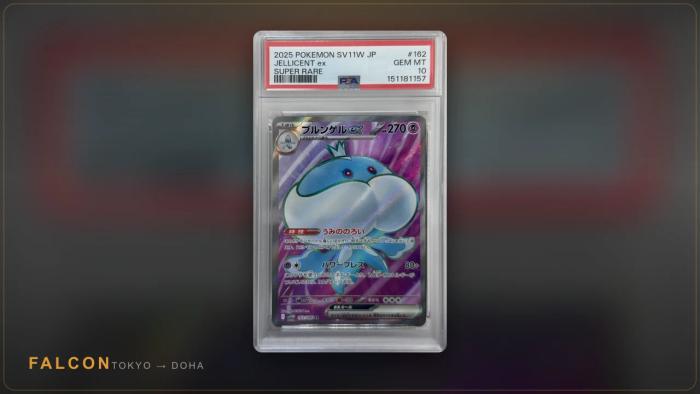
Professional grading companies such as PSA examine a card for authenticity and condition, then seal it inside a tamper-evident case with a unique certification number. For a buyer, a graded card removes much of the guesswork, because the card has already been assessed by experts whose job is to catch counterfeits, and the certification number can be checked against the grading company's own database. This does not make grading a magic guarantee, but it is one of the strongest signals of authenticity available to an ordinary buyer.
Grading matters most on higher-value cards, where the cost of authentication is small relative to the price and the risk of buying a fake is highest. It is worth knowing that counterfeiters sometimes fake the cases themselves, so you should still verify the certification number online and check that the case and label look correct. When a raw card is expensive and you have any doubt, the safe path is to buy it already graded, or to have it professionally authenticated rather than relying only on your own inspection.
How to Buy Authentic Cards Safely in Qatar
The habits around a purchase matter as much as the card itself. Buy from sellers who show real photographs of the exact card you will receive, not stock images borrowed from other listings. Ask for extra photos of the back, the edges, and the surface under angled light, and be wary of any seller who refuses or only sends low-resolution images. A genuine seller with a genuine card has no reason to hide detail.
Prefer sellers who are transparent about sourcing and who stand behind authenticity. For valuable Japanese cards, buying graded or from a specialist that verifies certification before dispatch dramatically lowers your risk. A price that seems far below the going rate is one of the most reliable warning signs of all, because genuine cards rarely sell far under their market value. When something feels too cheap, assume there is a reason and slow down.
- Insist on real photos of the exact card, including back, edges, and surface under angled light.
- Be suspicious of prices well below the normal market range.
- For higher-value cards, prefer graded copies or a specialist that verifies authenticity before shipping.
- Use payment methods that offer some buyer protection where possible.
- Ask direct questions about sourcing and authenticity, and treat vague or evasive answers as a red flag.
FALCON is a cross-border store operated by HAKOBUNE, based in Tokyo, that ships Japanese Pokémon cards to collectors in Qatar. Its catalogue centers on PSA-graded Japanese singles alongside carefully sourced raw cards and factory-sealed Japanese boxes. Every listing uses FALCON's own photographs of the actual card, certification numbers are verified before dispatch, and support is available in English. FALCON is an independent business and is not affiliated with The Pokémon Company, Nintendo, or PSA.
A Final Red-Flag Checklist
Before you pay, run through a short mental checklist. No single point on its own proves a card is fake, but several warning signs together are a strong reason to walk away. When a card is valuable and you remain unsure after your own checks, seek a professional opinion rather than gambling on it.
- Too much light passes through in the light test.
- Coarse, blurry, or irregular printing dots under magnification.
- Back color, swirl, or logo that differs from a genuine card.
- Fonts, small text, or energy symbols that look wrong.
- Gloss or holo pattern that does not match the real card.
- Rough, frayed, or unevenly cut edges and corners.
- A price far below the normal market range.
- A seller who avoids sending detailed photos or answering direct questions.
Frequently asked questions
How can I quickly tell if a Pokémon card is fake?
Start with the light test and a gentle flex to judge the cardstock, then examine the printing under magnification for a fine dot pattern, and compare the back color and fonts against a card you know is genuine. No single test is conclusive, so combine several checks. If multiple checks fail, the card is very likely fake.
Are Japanese Pokémon cards harder to fake than English ones?
Counterfeiters target both, but Japanese cards are popular and scarce outside Japan, which makes them a frequent target. The same checks apply: cardstock, print quality, back design, fonts, energy symbols, gloss, and edges. Comparing a suspect card against a genuine Japanese card of the same set is the most reliable approach.
Does the light test always work?
The light test is useful but not foolproof. Genuine cards are largely opaque because of a dark inner core, so many fakes let too much light through. However, some higher-quality fakes imitate this, so use the light test together with print, back, font, and edge checks rather than on its own.
Is a graded card guaranteed to be authentic?
Professional grading is a strong signal of authenticity because experts assess the card and seal it with a certification number you can verify online. It is not an absolute guarantee, since counterfeiters occasionally fake the cases themselves, so always verify the certification number and check that the case and label look correct.
Should I get my valuable cards professionally authenticated?
For higher-value cards, yes. Your own checks help filter out obvious fakes, but professional authentication or buying an already graded copy gives far more confidence. The cost of grading is small compared with the price of an expensive card and the loss of buying a fake.
What is the biggest warning sign of a counterfeit?
A price far below the normal market range is one of the most reliable red flags, because genuine cards rarely sell far under their market value. Combine that with any physical warning sign, such as poor printing or the wrong back color, and you should assume the card may be fake.
How do I buy Japanese Pokémon cards safely in Qatar?
Buy from sellers who show real photos of the exact card, ask for detailed images of the back, edges, and surface, and prefer graded cards or a specialist that verifies authenticity before shipping for anything valuable. Avoid deals that seem too cheap, and treat vague answers about sourcing as a reason to walk away.